Alliteration isn't just a playful tongue twister or a poetic flourish; it's a potent, sophisticated tool when wielded with precision. Move beyond the basic definition, and you unlock a world where sound doesn't just decorate your words, but actively shapes meaning, evokes emotion, and cements your message in the reader's mind. Yet, mastering this art means understanding not just how to use it, but when—and more importantly, the subtle yet significant advanced techniques and common mistakes when using alliteration that separate the skilled wordsmiths from the merely accidental.
This isn't about simply repeating a sound; it's about crafting an auditory experience that elevates your prose, makes your marketing sing, or imbues your characters with unforgettable qualities. Let's delve deep into making every alliterative choice a deliberate, powerful one.
At a Glance: Crafting Potent Alliteration
- Focus on Sound, Not Letters: Prioritize phonetic similarity (e.g., "cell" and "sell" alliterate).
- Use Sparingly and Strategically: Alliteration should enhance, not overwhelm your message.
- Context is King: Ensure the sounds you choose align perfectly with your content's tone and theme.
- Vary Your Approach: Mix initial, internal, and even related assonance/consonance for dynamic impact.
- Read Aloud: Always test your alliteration by speaking it to catch awkward phrasing.
- Every Instance Needs Purpose: Avoid decorative alliteration; it must serve a function.
- Banish Clichés: Strive for fresh, original phrases that genuinely surprise and engage.
- Mind the Overlap: Don't confuse alliteration strictly with assonance or consonance, but recognize their combined power.
Beyond the Basics: Unpacking Alliteration's True Power
At its core, alliteration is the repetition of initial consonant sounds in words that are close together. This simple phonetic pattern, however, carries immense power. It lends musicality and rhythm to writing, making phrases more memorable, enhancing emphasis, and adding a layer of depth that captivates an audience. Think of it as painting with sound, where each carefully chosen consonant adds texture and tone.
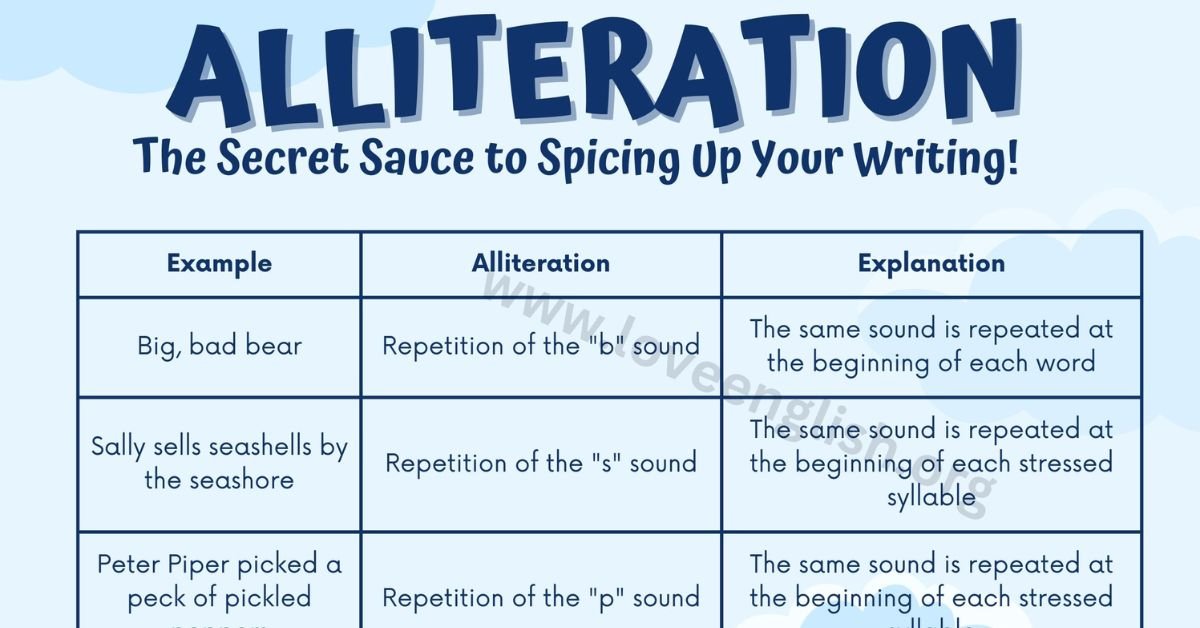
While the "Peter Piper picked a peck of pickled peppers" example might be the most famous, it merely scratches the surface. True mastery lies in understanding the nuanced types of alliteration and how they can be woven into the fabric of your narrative.
The Nuances of Sound: Decoding Alliteration's Forms
Not all repetition of consonant sounds is created equal. Understanding the distinct forms of alliteration, and recognizing related sonic devices, will allow you to deploy them with surgical precision.
- Initial Alliteration: This is the classic form, where the repeated consonant sound appears at the beginning of words. It's the most common and often the easiest to spot, instantly adding rhythm and memorability.
- Example: "The silent serpent slithers secretly."
- Internal Alliteration: Here, the repetition of consonant sounds occurs within words, rather than just at their start. This form is more subtle, often creating a sustained sonic texture rather than a sharp, rhythmic beat.
- Example: "The silky snake slithered silently." (Note the 'l' sound repeated internally).
- Head Rhyme (True Alliteration): This goes a step further than initial alliteration. It involves the repetition of both the initial consonant and the following vowel sound. This creates a stronger, almost rhyming effect at the beginning of words, forging a tighter bond between them.
- Example: "More and more," "Fine and fine."
While alliteration focuses on consonant sounds, it's often enhanced by or confused with related sonic devices: - Assonance: The repetition of vowel sounds within words that are close together.
- Example: "The rain in Spain stays mainly in the plain." (Repetition of the long 'a' sound).
- Consonance: The repetition of consonant sounds within or at the end of words, regardless of their position. This is a broader category than internal alliteration, which specifically looks for repetition within the words.
- Example: "He struck a streak of bad luck." (Repetition of 'ck' and 'd' sounds).
Understanding these distinctions helps you move beyond just "initial alliteration" and develop a more sophisticated ear for the sonic landscape of your writing.
Structuring for Impact: Where to Place Your Pearls of Sound
Alliteration isn't just about choosing the right words; it's about arranging them strategically. The structural breakdown of an alliterative phrase dictates its effectiveness.
- Proximity is Key: Alliteration typically involves at least two phonetically similar words in close proximity. The closer they are, the more immediate and pronounced the effect.
- The Power of Three (or More): While two words can create a subtle link, using three or more words strengthens the impact significantly. This creates a rhythmic pattern that’s harder to ignore and more memorable. Think "big, bad bully" versus "big bully." The third word amplifies the feeling.
- Strategic Placement: Placing alliterative phrases at the beginning of important phrases, clauses, or even sentences can draw immediate attention. It signals significance, much like an underline or bold text, but with an auditory cue. This technique is particularly effective in headings, taglines, or pivotal moments in a narrative.
Alliteration with Purpose: More Than Just Pretty Sounds
The true mark of advanced alliteration isn't just its presence, but its purpose. Every instance should contribute meaningfully to your message, whether through character, theme, or structure.
Crafting Character Through Consonants
Alliteration can subtly yet powerfully define character traits, making them more vivid and memorable.
- Sharp or Stern: The repetition of hard 't' or 'd' sounds can suggest a sharp tongue or decisive demeanor. Imagine a "stern, strong general."
- Menacing or Sly: J.R.R. Tolkien's Gollum, with his hissed "s" and "sh" sounds, immediately conveys menace and otherness. Similarly, Darth Vader's deep, guttural 'd' and 'v' sounds project raw power and a formidable presence. These aren't accidental; they're deliberate sonic choices that resonate with the character's essence.
- Logical or Precise: In science fiction, a character like Mr. Spock (from Star Trek) often uses 's' and 'p' sounds to emphasize logic and precise speech, reinforcing his stoic demeanor.
Weaving Thematic Resonance
Alliteration can create continuity or connection between narrative elements, subtly reinforcing your story's underlying themes.
- Journey and Movement: Repetitive 'j' or 'w' sounds can subtly mimic the feeling of movement or a meandering journey, guiding the reader through the narrative's physical or emotional path.
- Struggle and Persistence: In F. Scott Fitzgerald's The Great Gatsby, the 'b' sound in phrases like "boats against the current, borne back ceaselessly into the past" emphasizes the characters' struggle against their history and desires, echoing the novel's core theme of inescapable pasts.
Shaping Narrative Structures
Beyond individual sentences, alliteration can influence the very rhythm and flow of your entire narrative.
- Rhythm and Flow: In linear narratives, consistent alliteration can create a pleasing rhythm, pulling the reader along smoothly. It can mimic the pace of speech or action.
- Disjointedness: Conversely, deliberately jarring or inconsistent alliteration (or its absence where expected) can create a sense of disjointedness, reflecting chaos, confusion, or a non-linear narrative structure.
Enhancing Genres
Alliteration finds unique applications across different literary and commercial genres.
- Poetry's Musicality: In poetry, such as Edgar Allan Poe's "The Bells," alliteration is a cornerstone of musicality, building evocative soundscapes that echo the subject matter. The "tintinnabulation of the bells" isn't just descriptive; it's an auditory experience.
- Sci-Fi's Otherworldliness: As mentioned with Mr. Spock, alliteration can lend an alien quality or distinct voice to characters or settings in science fiction, emphasizing their "otherness."
Branding and Marketing Memorability
In the commercial world, alliteration is a powerful tool for memorability and brand recognition.
- Catchy Names: Coca-Cola, Best Buy, Dunkin' Donuts – these names aren't just easy to say; their alliterative quality makes them inherently catchy and easier to recall, creating instant brand recognition. This principle extends to slogans and taglines.
Mastering the Craft: Advanced Techniques for Potent Alliteration
Moving beyond accidental alliteration requires deliberate practice and a sharp ear. Here are the actionable insights for wielding this device with true mastery.
1. Focus on Sound, Not Letters: The Phonetic Imperative
This is perhaps the most critical advanced technique. Alliteration is about phonetic similarity, not just identical starting letters.
- The Trap: Many writers fall into the trap of only looking for words starting with the same letter, ignoring their sound.
- The Mastery: "Cell" and "sell" alliterate because they share the same initial 's' sound. "Know" and "nice" do not alliterate, even though both start with 'k' and 'n' respectively, because the 'k' in "know" is silent, and the 'n' sound in "nice" is distinct from the silent 'k'. Always say the words aloud. Does the initial sound match?
2. Use Sparingly & Strategically: The Art of Subtlety
Alliteration should enhance, not overwhelm. Overuse is the fastest way to make your writing sound forced, silly, or repetitive.
- The Trap: Littering every sentence or paragraph with alliteration makes it lose its impact and can distract from your message. It becomes a gimmick.
- The Mastery: Think of alliteration like a spice: a pinch enhances the flavor; a spoonful ruins the dish. Use it for emphasis on key phrases, to introduce a significant character, or to create a specific mood in a contained section. Its rarity will make its appearance more impactful.
3. Context is King: Aligning Sound with Sense
The sounds you choose must align with the tone, mood, and themes of your narrative.
- The Trap: Using harsh 'k' or 'g' sounds in a tender love poem, or soft 's' and 'l' sounds during a high-octane action sequence.
- The Mastery:
- Harsh sounds (k, g, t, d, p, b): Can evoke anger, power, struggle, or decisiveness. "The crushing creature crumbled cruelly."
- Soft sounds (s, sh, f, v, l, m, n): Can suggest gentleness, serenity, fluidity, or menace (with 's' and 'sh' particularly). "The soft silk swam slowly."
- Plosives (p, b, t, d, k, g): Create a sharp, percussive effect.
- Sibilants (s, sh, z, ch, j): Produce a hissing or buzzing sound.
Consider the emotional weight of your sounds. What feeling do you want to convey?
4. Vary Sounds & Placement: Keeping It Fresh
Mixing up the types of alliteration and their placement prevents monotony and adds interest.
- The Trap: Sticking only to initial alliteration with the same few sounds.
- The Mastery: Incorporate internal alliteration for a more sustained effect. Experiment with head rhyme for stronger connections. Don't forget how assonance and consonance can work with alliteration to create a richer tapestry of sound. Distribute alliterative phrases; don't just dump them all at the beginning of sentences. Varying the initial consonant sounds you use keeps your writing dynamic.
5. Read Aloud: The Ultimate Litmus Test
Your ears are your best editor when it comes to sound devices.
- The Trap: Relying solely on visual inspection, which can miss awkward phrasing or unintended sonic effects.
- The Mastery: Always read your writing aloud. Does the alliteration flow naturally? Does it sound forced or clunky? Does it create the desired auditory effect? If it stumbles on your tongue, it will stumble in the reader's mind. This practice is indispensable for refining rhythm and catching unintended rhymes or repetitive patterns.
6. Always Use with Purpose: Beyond Decorative Flourish
Every instance of alliteration should serve a clear function.
- The Trap: Inserting alliteration simply because it sounds clever, without a deeper reason. This makes your writing feel superficial.
- The Mastery: Ask yourself: "Why am I using alliteration here?" Is it to:
- Emphasize a key word or concept?
- Create a specific mood or atmosphere?
- Enhance rhythm and flow?
- Bind related ideas together?
- Characterize a person or place?
If you can't articulate a clear purpose, delete it. Sometimes, finding the perfect phrase requires a little inspiration. Our alliteration generator tool can be a fantastic springboard for fresh ideas, helping you explore different sounds and combinations to match your specific intent.
7. Banish the Cliché: Seek Originality
Avoid tired and overused alliterative phrases.
- The Trap: Falling back on phrases like "busy as a bee" or "right as rain" when they don't add anything new or specific to your context.
- The Mastery: Strive for original and creative alliterative phrases that surprise and delight the reader. This often means breaking away from the most obvious word choices and digging deeper into your vocabulary. A fresh turn of phrase elevates your writing from merely competent to truly captivating.
Steering Clear of the Stumbles: Common Alliteration Mistakes to Avoid
Even seasoned writers can trip up with alliteration. Recognizing these pitfalls is as crucial as understanding the techniques.
1. The Letter-Over-Sound Trap
As emphasized earlier, focusing on the visual letter rather than the auditory sound is a cardinal sin in alliteration. Words like "city" and "kind" share no initial consonant sound, despite the similar appearance of 'c' and 'k' in English. This mistake instantly breaks the sonic effect you're aiming for.
2. The Overwhelm: Too Much of a Good Thing
Overusing alliteration is perhaps the most common mistake. When every sentence or even every other word features a repeated sound, your writing becomes:
- Repetitive: It loses its novelty and quickly grates on the ear.
- Unnatural: It sounds forced and distracts from the content.
- Distracting: The reader focuses on the sound device itself rather than the meaning of your words. Your message gets lost in a cacophony of consonants.
3. Forcing the Fit: Awkward Phrasing
Trying to cram alliteration into a sentence where it doesn't naturally belong often leads to clunky, awkward phrasing. You might resort to synonyms that don't quite fit the context or rearrange sentences in an unnatural way, all in the pursuit of a sonic pattern. The result is writing that feels stilted and artificial. Good alliteration should feel organic and effortless, enhancing the flow, not disrupting it.
4. The Cliché Pitfall: Tired and Trite
Relying on tired, overused alliterative clichés ("bright and bushy-tailed," "cool, calm, and collected") drains your writing of originality and impact. These phrases have lost their freshness and often come across as lazy. While they might be recognizable, they do little to engage a sophisticated reader or contribute new meaning. Always aim for something fresh, even if it's a slight twist on a familiar phrase.
5. Ignoring the Narrative: Tone-Deaf Alliteration
Alliteration must always serve the overall context, meaning, and tone of your writing. Using cheerful, light alliteration in a somber piece, or aggressive, hard sounds in a tender scene, creates dissonance. This makes the alliteration inappropriate for the message and can undermine the intended mood or emotion, confusing your audience. The sound must align with the sense.
Sharpening Your Ear: How to Develop an Alliterative Eye
To truly master alliteration, you need to become a keen observer and listener.
- Read Widely and Critically: Pay close attention to how established authors, poets, and even advertisers use alliteration. Highlight examples you find compelling. How do they deploy it? Where do they place it?
- Analyze the Context: Once you identify alliteration, don't just note its presence. Analyze why it's there. What is the author trying to achieve? How does it contribute to the tone, mood, themes, or characterization?
- Look for Patterns: Identify patterns in repeated sounds and their significance. Do certain sounds appear repeatedly with a particular character or in certain types of scenes? What effect does this create? Developing this analytical skill will empower you to apply these observations to your own work.
Your Next Steps: Weaving Alliteration Wisely into Your Work
Alliteration, when used with wisdom and intention, is a secret weapon in a writer's arsenal. It's not about how often you use it, but how powerfully each instance resonates.
Start by experimenting. Take a piece of your writing and identify opportunities where a subtle alliterative touch could enhance a key phrase, draw attention to an important idea, or inject a specific mood. Don't force it. Remember the lessons: focus on sound, use it sparingly, align it with your context, and always, always read it aloud.
The goal isn't just to write words, but to craft an experience. By understanding the advanced techniques and common mistakes, you're not just repeating sounds; you're orchestrating a symphony of meaning. Make your words not just seen, but truly heard.