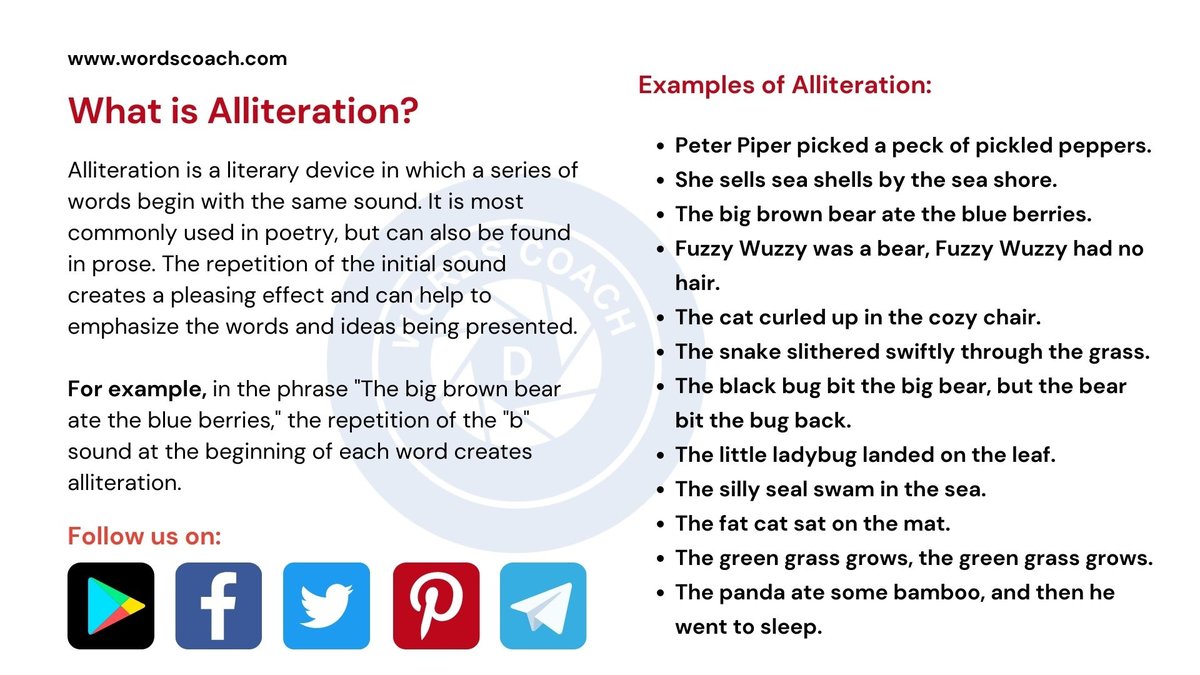
Ever noticed how certain phrases just stick? Or how a line of poetry seems to sing, even before you understand its meaning? Often, that magic comes from a deceptively simple literary device: alliteration. Understanding the basics of alliteration—its definition, myriad examples, and profound literary impact—isn't just for poets; it’s for anyone who wants to write with more rhythm, emphasis, and memorable flair.
At its heart, alliteration is a sound game, a subtle linguistic dance that adds music and meaning to words. It’s a tool that can make your writing resonate, whether you’re crafting a captivating novel, a snappy marketing slogan, or even just trying to remember a tricky name.
At a Glance: Alliteration Essentials
- What it is: The repetition of the same sound at the beginning of closely connected words.
- Sound over letter: It's about how words sound, not just how they're spelled (e.g., "cool cars" and "kind cats" both alliterate with the /k/ sound).
- Where it lives: Poetry, prose, advertising, common phrases, names, and song lyrics all use it.
- Why it matters: It creates rhythm, adds emphasis, sets mood, builds vivid imagery, and makes language more memorable.
- How to use it well: Subtly, purposefully, and always by reading your writing aloud to hear its effect.
The Rhythmic Resonance: What Exactly Is Alliteration?
Let's cut right to the chase: alliteration is the repetition of the same sound at the beginning of closely connected words. This isn't just a fancy trick; it's a fundamental building block of compelling language. Crucially, we're talking about sound, not merely the same initial letter. Think "Cool cars" and "Kind cats"—both employ alliteration because they share the same hard 'C' or 'K' sound: /k/. The spelling differs, but the sonic impact is identical.
This repetition usually occurs in the first letter of each word, but it can also be found in the stressed syllables of those words. While historically, the "stressed syllable" interpretation was dominant, both definitions are widely accepted today. However, many poets still gravitate towards repeating sounds on emphasized syllables for maximum impact. Words don't even need to be immediately next to each other; other words can appear between them, as long as the alliterative words feel "closely connected" in the phrase or sentence.
And what about vowels? While often associated with consonants, vowels can also alliterate if the sound is consistent. Consider "American alliteration" or "apt apples." Here, the repeated short 'a' sound creates the alliterative effect. The key, always, is the consistent initial sound.
A quick note on nuance: Sometimes, consonant clusters like "sp," "sk," or "st" spark debate. Do "splendid" and "sparkling" alliterate? Many argue yes, treating the entire cluster as a distinct initial sound. However, "splendid" and "single" would not, as the initial 's' sound is followed by different subsequent sounds. These are subtle distinctions, but they highlight the deep linguistic awareness behind effective alliteration. For a broader perspective on how sound shapes language, you might explore other sound devices in poetry.
Not to Be Confused: Alliteration vs. Its Sound Siblings
The world of literary devices is rich with techniques that manipulate sound, and alliteration has a couple of close relatives that often get mistaken for it. Understanding the differences helps you wield each tool with precision.
Consonance: The Broader Consonant Cousin
Imagine repeating consonant sounds throughout words, not just at the beginning. That's consonance. The repeated sound can occur at any point within the word—beginning, middle, or end.
- Example of Consonance: "Mike likes his new bike." (The /k/ sound repeats, but not always at the beginning).
- Example of Alliteration: "Big bears bounce." (The /b/ sound repeats specifically at the beginning).
Consonance offers a subtler, often more pervasive sonic texture, weaving a consistent sound tapestry through a phrase or sentence without the overt "pop" of alliteration.
Assonance: The Vowel's Echo
Similar to consonance, but with vowels, assonance is the repetition of similar vowel sounds across several words. Again, these sounds can occur at any point within the word.
- Example of Assonance: "Go slow on the road." (The long 'o' sound repeats).
- Example of Alliteration (Vowel): "Often outstanding options." (The long 'o' sound repeats at the beginning).
Alliteration is a specialized form of these devices. While consonance and assonance involve repeated sounds anywhere in words, alliteration specifically demands those repeated sounds at the beginning of words or on their stressed syllables. Think of it as the most front-loaded of the sound repetitions.
The Secret Sauce: Why Writers Wield Alliteration
Writers, poets, advertisers, and even everyday communicators employ alliteration not just for decoration, but for specific, powerful rhetorical effects. It’s a versatile tool that can transform bland text into something memorable and impactful.
Rhythm and Musicality: Setting the Beat
At its most fundamental, alliteration adds a pleasing, musical quality to writing, particularly in poetry. The rhythmic repetition creates a flow, a kind of internal beat that makes lines easier to read aloud and more enjoyable to hear. Think of Edgar Allan Poe's "While I pondered, weak and weary" or the iconic opening from Shakespeare's Romeo and Juliet: "From forth the fatal loins of these two foes." The repeated 'w' and 'f' sounds, respectively, give these lines an undeniable cadence.
Emphasis: Drawing the Reader's Eye (and Ear)
Alliteration is a fantastic way to draw attention to specific words or phrases. By linking words through sound, you highlight them, making them stand out from the surrounding text. This can be used to underscore important ideas, create a sense of urgency, or simply make a statement more impactful. A carefully chosen alliterative phrase can subtly guide the reader towards what matters most.
Mood and Tone: Sounding Out Emotion
The choice of consonant sounds can profoundly contribute to the overall mood and tone of a piece. Harsh, plosive sounds (like 'b', 'd', 'k', 't') can evoke aggression, tension, or bluntness. Consider "Big, belligerent brute." Softer, sibilant (hissing) sounds (like 's', 'sh', 'f') or liquid sounds (like 'l', 'r') can evoke tranquility, softness, sorrow, or mystery. Imagine "Silent, shimmering sea" versus "Rough, roaring rapids." Each choice creates a distinctly different sonic landscape and emotional feel.
Imagery: Painting Pictures with Sound
By connecting sounds with sensory experiences, alliteration can create vivid and memorable imagery. The very sound of the words can conjure up sights, smells, or feelings. "Whispering winds" doesn't just describe; the 'w' sound almost replicates the soft rush of air. "Crunching carrots" helps you hear the crisp snap. It deepens the reader's immersion by engaging more senses.
Memorability: Making it Stick
This is where alliteration truly shines in everyday use. Phrases that alliterate are simply catchier and easier to remember. This cognitive stickiness is why it's a staple in advertising, brand names, and common idioms. Once you hear it, it often stays with you. If you’re looking to make your writing stickier, or just want to experiment with different sound effects, Our alliteration generator tool can be a playful way to find new combinations.
Alliteration in Action: A Kaleidoscope of Examples
Alliteration isn't confined to dusty old poems; it's everywhere. From ancient epics to modern marketing, its power to enhance and make memorable is universally recognized.
In Poetry: Classic Cadences
Poetry is arguably alliteration's oldest stomping ground. Poets have long harnessed its rhythmic and emphatic qualities:
- "Deep into that darkness peering, long I stood there wondering, fearing..." – Edgar Allan Poe, "The Raven" (Repetition of 'd' and 'w' sounds)
- "Fair is foul, and foul is fair: Hover through the fog and filthy air." – William Shakespeare, Macbeth (Repetition of 'f' sound)
- "In a summer season, when soft was the sun." – William Langland, Piers Plowman (An example from Old English poetry, where alliteration was a core structural element)
In Prose: Adding Punch to Paragraphs
Even in everyday prose, a touch of alliteration can elevate a description:
- "The silent sea shimmered seductively under the sun." (The soft 's' sound creates a serene, almost hypnotic atmosphere.)
- "He boldly broke through the barrier, bellowing battles." (The hard 'b' sounds convey force and aggression.)
In Advertising: Brand Recognition at its Best
Marketers know that memorability sells. Alliteration is a prime tool for creating catchy brand names and slogans:
- Brand Names: Krispy Kreme, Best Buy, Coca-Cola, PayPal, Dunkin' Donuts.
- Slogans: "Practically Perfect in Every Way" (Mary Poppins, which functions like a slogan), "A Mars a day helps you work, rest and play."
- "Powerful products for people."
In Common Phrases and Idioms: Everyday Language
Alliteration is so ingrained in our language that we use it without even noticing:
- "Petty price"
- "Sound sleep"
- "With wealth and wisdom"
- "Doing deadly deeds"
In Tongue Twisters: Playful Practice
While not synonymous, tongue twisters frequently utilize alliteration to create their challenging charm:
- "Peter Piper picked a peck of pickled peppers."
- "She sells seashells by the seashore."
In Character Names: Unforgettable Identities
Many beloved characters have alliterative names, making them easier to remember and giving them a certain memorable punch:
- Comic Books: Bruce Banner, Clark Kent, Peter Parker, Lois Lane, Lex Luthor.
- Cartoons: Mickey Mouse, Donald Duck, Bugs Bunny, Fred Flinstone.
- Literature: Luna Lovegood, Severus Snape (from Harry Potter).
In Song Lyrics: Melodic Moments
Songwriters often lean on alliteration to enhance rhythm and create memorable lines:
- "I've forgotten how it felt before the world fell at our feet." – Adele, "Rolling in the Deep" (Repetition of 'f' and 'w' sounds).
- "Singing softly some sweet songs."
These examples demonstrate the sheer versatility of alliteration. It's a linguistic chameleon, adapting its purpose and impact to fit any context. To truly appreciate its breadth, it helps to see it within the larger framework of language, which you can find in our comprehensive guide to literary devices.
Beyond the Gimmick: Mastering Alliteration for Impact
Alliteration is powerful, but like any strong flavor, too much can overwhelm. To use it effectively, you need a nuanced approach. Here’s how to go from merely noticing alliteration to mastering its subtle art.
Subtlety is Key: Less Is Often More
The most effective alliteration often goes unnoticed on a conscious level. It’s felt rather than explicitly recognized. Aim for subtle rather than overly obvious or repetitive patterns that might distract the reader. A gentle rhythm or a soft emphasis is usually more impactful than a barrage of repeated sounds that screams "alliteration!" It's about enhancing, not announcing.
Purposeful Use: Ask "Why?"
Before you insert an alliterative phrase, ask yourself: What rhetorical effect am I trying to achieve here? Are you aiming for:
- Rhythm? To make a line flow musically?
- Emphasis? To highlight a crucial word or concept?
- Mood? To evoke tranquility, tension, or joy?
- Imagery? To make a description more vivid and sensory?
- Memorability? To create a catchy phrase?
If your alliteration doesn't serve a clear purpose, it might just be decorative fluff. Purposeful application is what elevates it from a trick to a technique.
Avoid Overuse: Don't Let it Distract
Excessive alliteration can quickly become distracting, sounding forced, artificial, or even a little silly. When every other word begins with the same sound, the writing loses its natural cadence and risks becoming a tongue twister that tires the reader. Like a spice, use it sparingly to flavor your writing, not overpower it. A common pitfall for aspiring writers is to sprinkle alliteration indiscriminately; instead, be selective and strategic.
Read Aloud: The Ultimate Test
This is perhaps the single most important piece of advice for using any sound device, especially alliteration. Our eyes can deceive us; our ears rarely do. Reading your text aloud helps you:
- Hear the rhythm: Does it flow naturally, or does it stumble?
- Identify awkwardness: Does the repetition sound forced or unnatural?
- Assess the impact: Does it achieve the desired emphasis or mood?
If it sounds good to your ear, chances are it will resonate with your readers. This acoustic check is crucial for refining your prose and ensuring that alliteration truly enhances your message. For more ways to fine-tune the sound and flow of your writing, you might find guidance in articles on the power of rhythm in writing.
Common Questions & Clearing the Air
Alliteration can sometimes lead to confusion because of its nuances. Let’s clarify some common questions and misconceptions.
Does Alliteration Have to Be the First Letter?
No, not necessarily. While it often is, the definition hinges on the repetition of the same sound at the beginning of closely connected words, or on their stressed syllables. "Kind cats" and "Cool cars" both alliterate with the /k/ sound, even though one starts with 'K' and the other with 'C'. The sound is paramount.
Can Vowel Repetitions Be Alliteration?
Absolutely, yes. As long as the repeated sound is consistent and occurs at the beginning of words (or on their stressed syllables), it counts. "American alliteration" or "apt apples" are perfect examples where the repeated initial vowel sound creates the alliterative effect.
Is a Tongue Twister Always Alliteration?
Not always, but very often. Many tongue twisters rely heavily on alliteration for their challenging nature, like "Peter Piper picked a peck of pickled peppers." However, a tongue twister might also primarily use consonance or assonance, or a combination of various sound devices, to create its difficulty. Alliteration is a common ingredient, but not the sole definition of a tongue twister.
Do Alliterative Words Have to Be Immediately Sequential?
No. While often seen side-by-side, alliterative words do not have to be immediately sequential. Other words can appear between them. The key phrase is "closely connected." This means they should be in the same phrase, clause, or sentence, contributing to a unified sonic effect, rather than being spread too far apart to be perceived as a repetition.
What About Consonant Clusters (e.g., "sp", "st")?
This is a point of debate. Some purists argue that "splendid" and "single" do not alliterate because the 's' is followed by a different sound. Others argue that consonant clusters like "sp" or "st" function as their own distinct initial sounds, so "splendid" and "sparkling" would alliterate. For practical purposes, if the entire cluster (or at least the initial dominant sound of the cluster) is repeated, it generally feels alliterative to the reader's ear.
Your Turn: Crafting Catchy, Compelling Copy
Armed with a deeper understanding of alliteration, you're ready to wield this versatile tool in your own writing. Remember, it's not about forcing specific words; it's about listening to the sounds of language and strategically placing them for maximum impact.
Start by noticing it in the world around you – in news headlines, advertisements, song lyrics, and everyday conversations. Then, consciously try to weave it into your own sentences. Begin with simple pairings, like a descriptive adjective and a noun: "shimmering silence" or "daring dream."
As you practice, always read your work aloud. Your ears are your best editors when it comes to sound devices. You'll quickly develop an instinct for when alliteration enhances your message and when it might detract from it. Experiment with different consonant and vowel sounds, observing how they shape the mood and rhythm of your sentences. From crafting captivating characters to producing memorable prose, understanding how to effectively use alliteration is a crucial step in mastering figurative language and making your words truly sing.
Alliteration is more than just a stylistic flourish; it's a fundamental aspect of how language creates meaning, emotion, and memorability. Embrace its power, use it with purpose, and watch your writing become more resonant and truly unforgettable.